The Nazi Party Rally Grounds: what is left, and how to visit
How to go on your own, in full
Take tram 8 from the Hauptbahnhof towards Doku-Zentrum, or the S-Bahn to Frankenstadion. Fifteen minutes, an ordinary city single. Get off and the Congress Hall is directly in front of you: a vast unfinished horseshoe of brick, modelled on the Colosseum and never roofed. The Documentation Centre occupies one wing of it.
From there the circuit is a walk of about two to three hours, and it is signposted with an outdoor information system with panels in German and English:
- The Congress Hall — the largest surviving Nazi building anywhere. Never finished, never roofed, now partly a depot and partly a museum. You can walk into the inner courtyard.
- The Great Road — two kilometres of granite paving, sixty metres wide, aligned on the castle two miles away. It now functions largely as a car park, which is either an indignity or exactly right depending on your view.
- The Zeppelinfeld and its grandstand — the one everybody comes for, at the far end round the Dutzendteich lake.
- The Dutzendteich itself — two lakes with a path round them, which is why half the people you pass are joggers and dog walkers rather than visitors.
Total outlay: two tram fares and one museum ticket. That is the honest cost of doing this properly on your own, and it is a legitimate way to spend an afternoon.
Do the Documentation Centre before you walk the grounds, not after. The museum is what makes the empty ground readable. In the other order you spend the walk looking at concrete and then spend the museum finding out what you missed.
The Zeppelin grandstand: what to expect
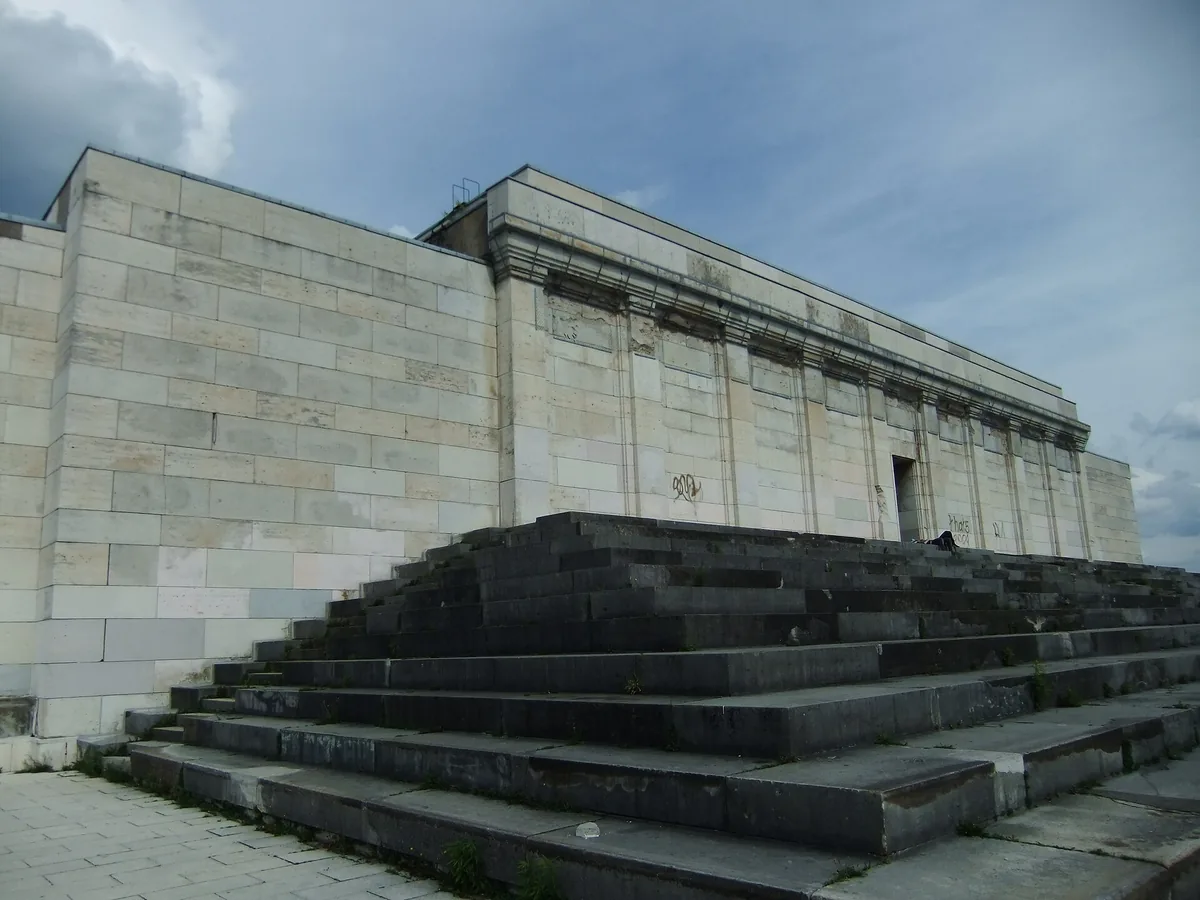
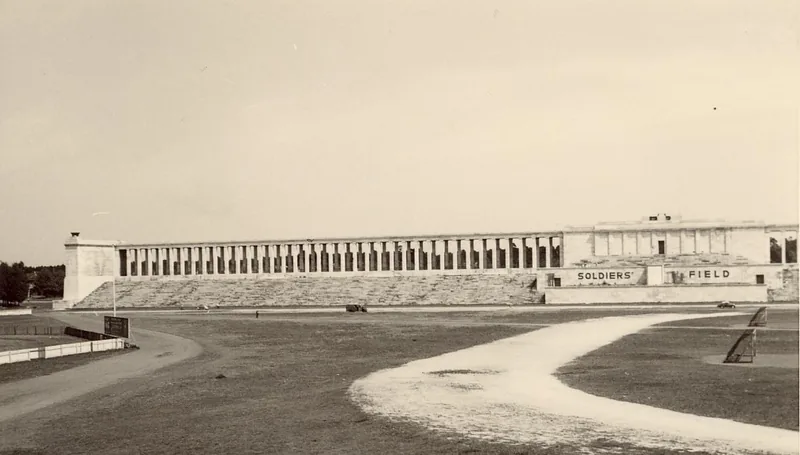
The Zeppelintribüne is the long stone terrace at the head of the field, and it is the structure in the newsreels. What survives is less than what was built: the colonnade along the top was demolished by the city in 1967 because it was unsafe, and the side towers were cut down to about half their height.
The city decided some years ago not to restore it and not to remove it, but to stabilise it — to stop it collapsing without making it look new, so that it stays available as evidence. That work is long-running and ongoing, which in practice means sections are fenced or under scaffolding at any given time and the arrangement changes. You should assume some part of it will be inaccessible on the day you go, and you should not build a trip around standing in one specific spot.
What you can rely on is the field itself, which is enormous, and the scale of the terrace seen from it. Most people are quieter here than they expected to be.
What it is like to be there
Unremarkable, which is the difficulty. There is no gate, no ticket office, no attendant and very little signage beyond the information panels. The grass is mown. People walk dogs. On a grey Tuesday in February you can stand on the Zeppelinfeld for twenty minutes and see nobody at all.
Nobody warns you that the great sites of the Third Reich now look like a district park with unusual paving, and the flatness is the thing visitors most often report being unprepared for. It is also, arguably, the correct outcome. Nuremberg spent decades deciding what to do with this ground and settled on neither shrine nor erasure.
Why a guide is worth it here, specifically
Everywhere else on this site I will tell you to walk it yourself and save the money. Here I would spend it, and the reason is physical rather than sentimental.
Four square kilometres of grass, water and unlabelled concrete does not explain itself. The grandstand reads as a terrace with weeds in it. The Great Road reads as a car park. Without someone to tell you where the camera stood for the footage you have seen, which axis you are walking along, what was demolished in 1967 and what was never built at all, you are looking at municipal parkland — accurately, and without understanding any of it. Interpretation is the product here in a way it is not at a castle.
A guide also solves the geography, which catches almost everyone out. The Palace of Justice, where the trials were held, is 2.2 km west of the old town. The rally grounds are 3.4 km south-east. The two sites everybody assumes are neighbours are six kilometres apart on different lines, and combined tours exist because that is an awkward morning to assemble yourself.
And there is somebody to ask. This material raises questions — about how the city lives with it, about what was kept deliberately, about why the grandstand is neither restored nor removed. A panel cannot answer a follow-up.
 Rally grounds
Nuremberg: Tour of Former Nazi Party Rally Grounds
 Rally grounds + trials
Nuremberg: Tour of the Nazi Rally Grounds and the Nuremberg Trials
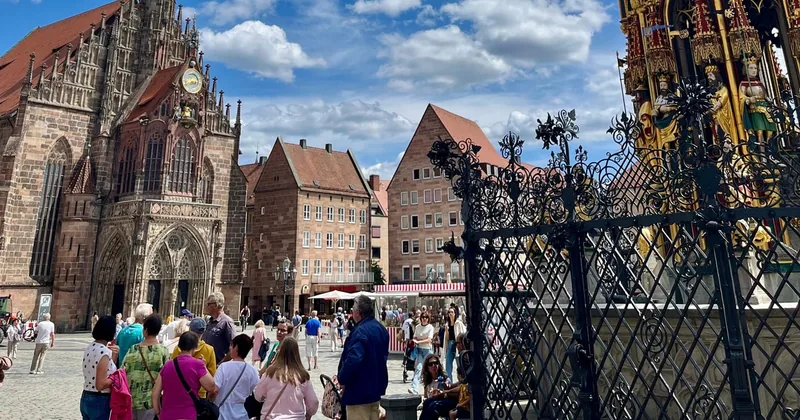 Rally grounds + Old Town
Nuremberg Rally Grounds and Old Town Walking Tour in English
The full comparison, including which tours include transport between the rally grounds and the Palace of Justice, is on Nazi-era tours compared.
Visiting respectfully
There is no rule sheet at the entrance, because there is no entrance. The city's own position is that this is a place for education rather than commemoration — it is not a memorial to victims, it is the ground the perpetrators built for themselves, and the two call for different behaviour. Ordinary photographs are fine and expected. Re-enacting anything on the grandstand is not, and Germany's laws on Nazi symbols and gestures apply in full and are enforced.
If it is memorials to victims you are looking for, the Way of Human Rights beside the Germanisches Nationalmuseum and the memorial at the former Jewish cemetery are both in the old town.
Frequently asked questions
Can you visit the Nazi party rally grounds in Nuremberg?
Yes, freely. The former rally grounds are public parkland in the south-east of the city with no gate, no ticket and no closing time. Tram 8 runs there from the main station in about fifteen minutes. Only the Documentation Centre at the Congress Hall charges admission.
How much does it cost to visit the Nuremberg rally grounds?
The grounds themselves are free. You pay only for public transport to get there and, if you go in, admission to the Documentation Centre. Guided tours are a separate choice and are worth considering because the site is large and almost entirely unlabelled.
Can you still see the Zeppelin grandstand?
Yes, though not all of it. The colonnade on top was demolished in 1967 and the side towers were reduced by half. The structure is under a long-running stabilisation programme, so some sections are fenced or scaffolded at any given time and the arrangement changes. The field and the scale of the terrace are always there.
How long do you need at the Nuremberg rally grounds?
Two to three hours for the full walking circuit round the Dutzendteich taking in the Congress Hall, the Great Road and the Zeppelinfeld, plus another hour and a half for the Documentation Centre. Half a day covers it comfortably.
Are the rally grounds and the Nuremberg trials courtroom in the same place?
No, and this is the most common planning mistake. The rally grounds are 3.4 km south-east of the old town; the Palace of Justice with Courtroom 600 is 2.2 km west of it. They are six kilometres apart on different lines, which is why combined tours with transport exist.