Where Is Nuremberg? Location, Region and What It Is Near
Is Nuremberg in Bavaria? Yes — but say Franconia
Administratively Nuremberg is unambiguously Bavarian, and has been since 1806. Culturally it is Franconian, and the distinction matters more here than a visitor expects. Franconia has its own dialect, its own beer traditions, its own food and a long-standing and only half-joking resistance to being called Bavarian. You will not see lederhosen, and the beer is different from Munich's. Calling a local a Bavarian is not an insult, but it is a small mistake worth not making.
How far is Nuremberg from everywhere else
| From | Distance | By train |
|---|---|---|
| Munich | 170 km south | About 1 hr 10 by ICE |
| Frankfurt | 220 km west | About 2 hrs by ICE |
| Berlin | 430 km north | About 3 hrs 10 by ICE |
| Prague | 300 km east | About 3 hrs 30 by coach |
| Bamberg | 60 km north | About 40 minutes |
| Rothenburg ob der Tauber | 80 km west | About 1 hr 15, with a change |
| Regensburg | 100 km south-east | About 1 hr |
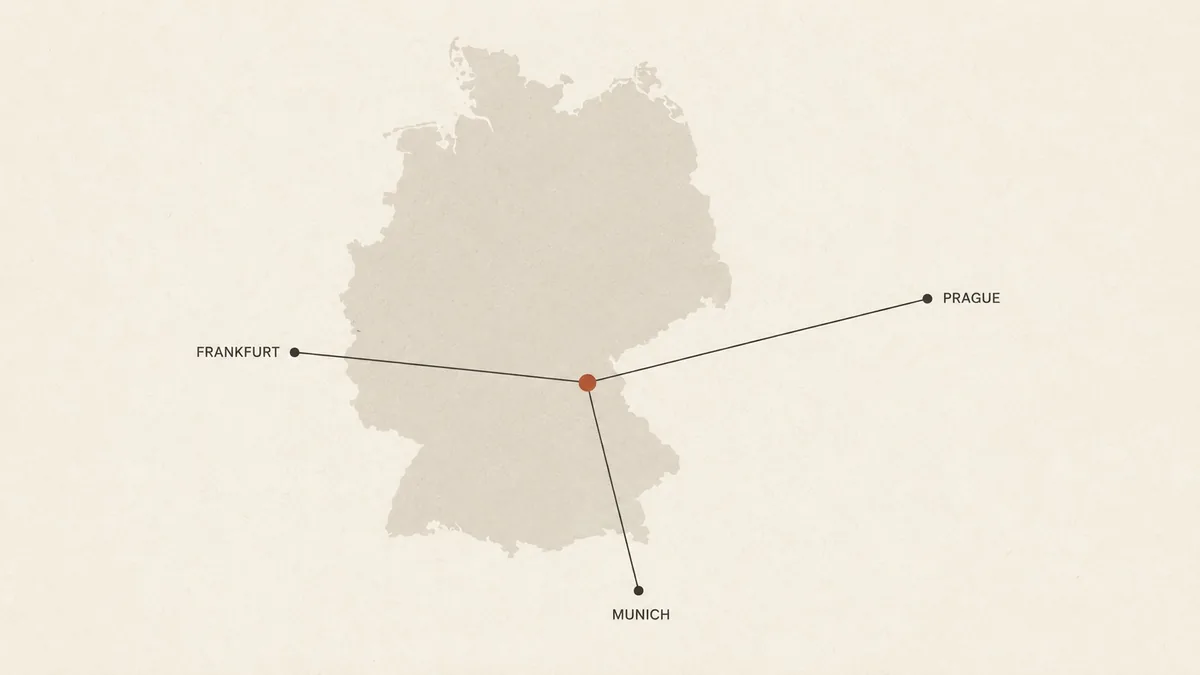
That central position is the practical reason to care about where Nuremberg is: it is on the main north-south ICE spine, which makes it one of the easiest cities in Germany to slot into a wider trip. Getting here, in detail.
What Nuremberg is near
Franconian Switzerland — a limestone landscape of crags, caves and small breweries — starts about half an hour north. Bamberg, a UNESCO-listed town that genuinely was not bombed, is forty minutes by train. Rothenburg, the walled town most people picture when they picture medieval Germany, is a manageable day trip west. The day trips worth taking.
What it is not near: the Alps. The mountains most people associate with Bavaria begin about two and a half hours south of here, past Munich. If Alpine scenery is the point of your trip, Nuremberg is a stop rather than a base.
Getting your bearings on arrival
Almost everything people picture when they picture Nuremberg sits inside the old town, and the old town is small: the castle to the Hauptmarkt is about six hundred metres downhill, and the Hauptmarkt to the main station is a little over a kilometre. You will not need a tram to see the centre. You will need one to reach the rally grounds, which are four kilometres south-east, and the Palace of Justice, which is two kilometres west — and those two are six kilometres apart from each other, which is the single fact that wrecks more Nuremberg itineraries than anything else.
The main station sits immediately outside the southern city wall, so you arrive about four minutes' walk from the medieval centre — unusually convenient, and worth knowing when you are choosing a hotel. See it all on the map, or read where to stay, by area.
Frequently asked questions
What country is Nuremberg in?
Germany. It is in the state of Bavaria, in the north of that state, in the region known as Middle Franconia.
Is Nuremberg in Bavaria or Franconia?
Both, and locals will tell you the second matters more. Franconia is a cultural and historical region that has been administratively part of Bavaria since 1806. The dialect, the beer and the food are all recognisably Franconian rather than Bavarian, and the distinction is a live one here.
How far is Nuremberg from Munich?
About 170 kilometres, or roughly 1 hour 10 minutes by ICE. Regional trains take closer to two hours but cost far less, especially on a Bayern-Ticket. The full comparison is here.
What river runs through Nuremberg?
The Pegnitz, which cuts the old town in two. The northern half is the Sebalder Seite, the southern half the Lorenzer Seite, each named after its main church. The castle stands above the Sebalder side.
How big is Nuremberg?
About 530,000 people, which makes it the second-largest city in Bavaria after Munich and roughly the fourteenth-largest in Germany. The wider metropolitan region holds around 3.5 million.