Nuremberg Old Town: what to see, and what you are actually looking at
The walk, in order
There is one obvious route and it works. Come out of the main station, cross under the ring road and enter through the Königstor, the great round tower. Immediately inside on your right is the Handwerkerhof, a walled courtyard of craft workshops built in 1971 — it is a tourist creation rather than a survival, and worth two minutes rather than twenty.
Walk up Königstrasse to St Lorenz, the great Gothic church with the two towers. Entry is free. Inside, look up: the Angelic Salutation hangs from the ceiling on a rope, carved by Veit Stoss in 1517 and one of the few major works that survived the war because it was taken down and hidden underground — in the purpose-built bunker you can now visit on the underground tour.
Cross the Pegnitz at the Museumsbrücke, with the Heilig-Geist-Spital arching over the water on your left, and you are on the Hauptmarkt. This is the square that becomes the Christkindlesmarkt for four weeks a year and an ordinary produce market the rest of the time. The Schöner Brunnen stands in the corner — the gold ring set into its railing is the one thing every visitor touches, and turning it is supposed to grant a wish. The Frauenkirche on the east side runs its mechanical clock, the Männleinlaufen, every day at noon; it lasts a couple of minutes and draws a crowd out of all proportion to what happens.
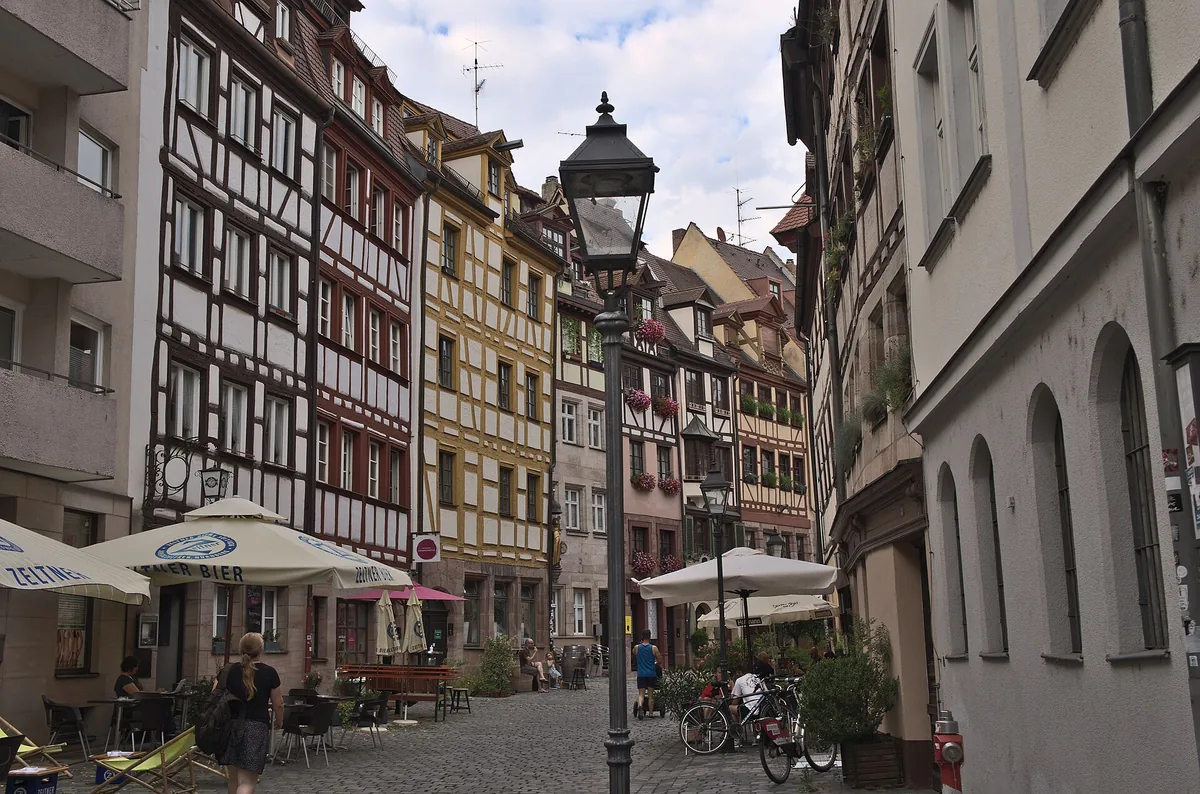
From there it is uphill: past St Sebaldus and the old town hall, along Weissgerbergasse — the tanners' street, and the one place where the half-timbered houses are genuinely original rather than rebuilt — and up to the Kaiserburg. The courtyard and ramparts are free and the view from them is the best in the city.
Two and a half hours at a walking pace, longer if you go into things. The whole route is on the map.
The thing the plaques do not say
On the night of 2 January 1945, an Allied raid destroyed the great majority of the medieval city in roughly an hour. What you walk through now is a reconstruction: deliberate, unusually careful, argued over for thirty years, and in places a reconstruction of a reconstruction.
Nuremberg made a choice other German cities did not. Rather than clearing the site and building a modern centre, or restoring every facade brick for brick, it rebuilt to the medieval street plan at medieval scale using modern methods — keeping the shape and the silhouette while allowing the buildings themselves to be honest about their age. The result is a city that feels old and is mostly not, and once you know to look for the seam you cannot stop seeing it.
None of that is written anywhere on the street. It is the single biggest reason to consider a walking tour here, and the reason walking tours in Nuremberg are unusually good: the guides all have to explain the same awkward thing, and they have got good at it.
 Classic 2 hours
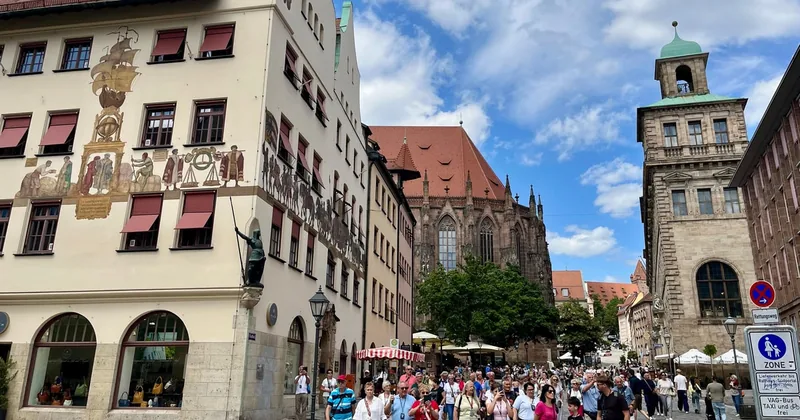
Nuremberg 2-Hour Old Town Guided Walking Tour in English
 Daily departure
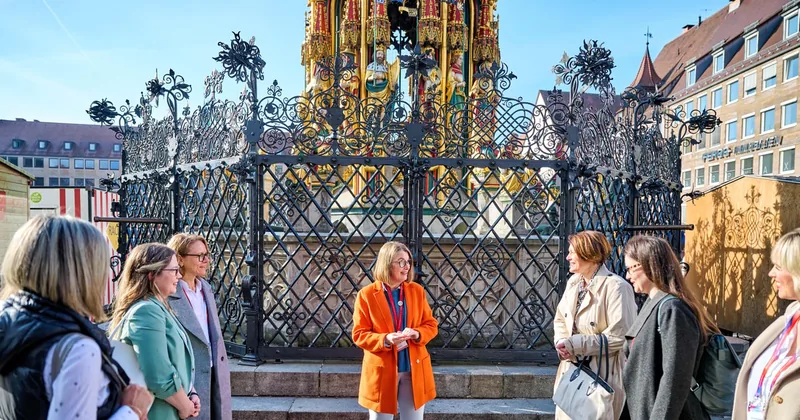
Nuremberg: Old Town Public Guided Walking Tour
 Tip-based
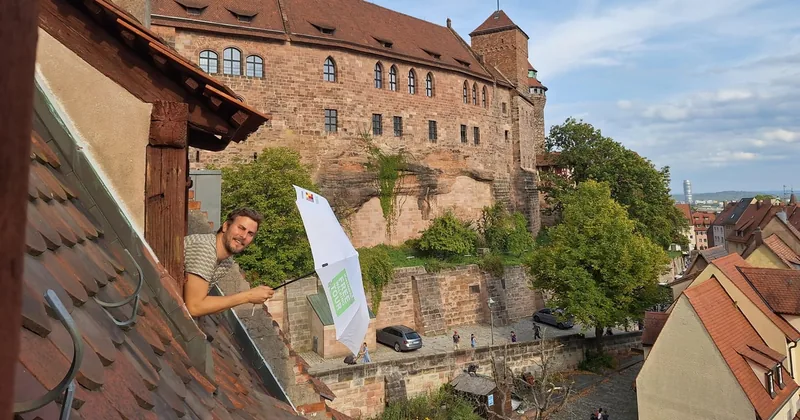
Nuremberg: Free Walking Tour
What is worth going inside
| Place | Cost | Worth it for |
|---|---|---|
| St Lorenz | Free (donation) | The Veit Stoss Annunciation hanging from the vault |
| St Sebaldus | Free (donation) | The bronze shrine, and far quieter than St Lorenz |
| Kaiserburg | EUR 10 combination | The Double Chapel, the Deep Well, the view |
| Germanisches Nationalmuseum | Around EUR 10 | The largest museum of German culture anywhere |
| Dürer House | Around EUR 7 | Where he actually lived, rebuilt after the war |
| Historic Rock Passages | From about EUR 16 | The cellars under the hill — guided only |
Weissgerbergasse in the early morning is the one photograph of Nuremberg that looks like the postcard, and by eleven it is full of people taking it. The street faces roughly north-east, so the light is better early anyway.
The city wall
Around five kilometres of it still stands, along with most of the towers and the dry moat, and it is free. Walking the moat from the Königstor round to the Neutor takes about forty minutes and is the quietest thing you can do in the centre — you are below street level, in a grassy trench, with the wall on one side and traffic you cannot see on the other. Almost nobody does it.
Inside parts of the wall there are tunnels and passages, and those are locked and shown by guides only — see underground Nuremberg.
Can’t make these dates?
Browse more tours and activities in Nuremberg and find one that fits your schedule — all with instant confirmation and free cancellation.
Frequently asked questions
Is Nuremberg old town worth visiting?
Yes, though it is worth knowing what it is. Around ninety per cent of the medieval centre was destroyed on 2 January 1945 and carefully rebuilt to the original street plan, so most of what looks medieval is post-war reconstruction. It is free to walk, compact, and the castle, the city wall and the two great churches are all genuinely worth the time.
How long do you need in Nuremberg old town?
About two and a half hours to walk from the main station through to the castle at a reasonable pace without going inside anything. A half day covers the walk plus St Lorenz and the castle. A full day lets you add a museum and the city wall.
What is the oldest street in Nuremberg old town?
Weissgerbergasse, the tanners' street, is the place to go for original half-timbered houses - it came through the 1945 raid comparatively intact, which is why it looks different from the rest of the centre.
Is the Nuremberg old town free?
Walking it costs nothing, and so do the two big churches, the city wall and the castle courtyard and gardens. Only the museums and the castle interior charge admission.
What happens at the Frauenkirche clock in Nuremberg?
The Maennleinlaufen mechanical clock runs at noon every day on the Frauenkirche facade on the Hauptmarkt. Seven figures representing the prince-electors process around the Emperor Charles IV. It takes a couple of minutes and draws a large crowd.